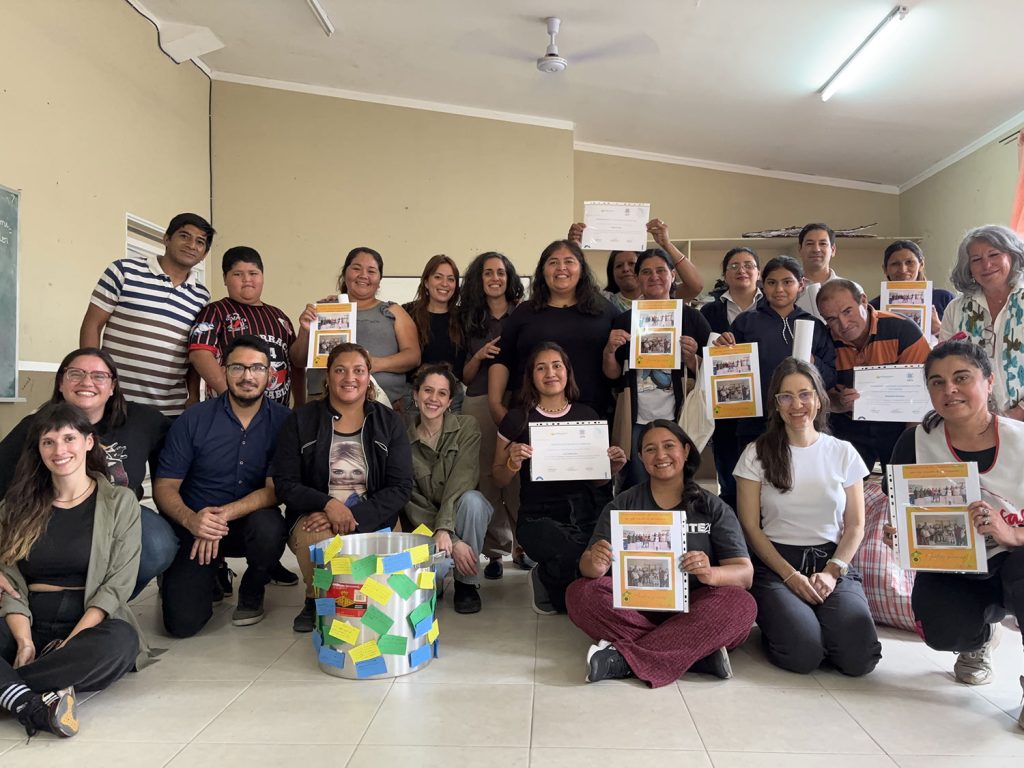
The non-governmental organization brings together evidence-based knowledge, community work, and long-term commitment to promote healthy, sustainable, and culturally appropriate food practices. It does so by supporting and driving processes rooted in local territories, always placing people at the center.
Transforming food systems requires time, evidence, and sustained relationships with those who inhabit the territories. With this conviction, Fundación Alimentaris—a nonprofit organization that seeks to amplify the impact of social, economic, and environmental initiatives—is implementing in Santiago del Estero a set of interconnected actions that link community knowledge with technical expertise, grounded in a long-term vision and a focus on collective well-being.
Working across different regions of Argentina, Alimentaris aims to strengthen local food systems in the province by raising awareness about the importance of healthy practices and by empowering key community actors, such as neighborhood cooks and local food producers. “At the heart of our approach is people’s holistic well-being. To achieve this, we look for new ways of doing things and invest in what shows promise,” explained Karina Bentivoglio, president of the Foundation.
Research as a Starting Point
As part of the Sustainable Food Systems (SAS) initiative, the first step was to generate proposals and ideas grounded in data. To this end, Alimentaris formed an alliance with the Institute for Social Development Studies (INDES – CONICET/UNSE) and the School of Humanities at the National University of Santiago del Estero to map, throughout 2024, the province’s productive structure and the family dynamics and dietary patterns of a specific neighborhood in the capital city: General Paz.
“Food is a fundamental human right that, due to its complexity, requires systemic and context-based approaches. At Alimentaris, we work with this perspective to promote access to healthy, sustainable, and culturally appropriate diets,” said Sol Laje, Director of Community Programs.
In Santiago del Estero, Family Farming—both peasant and Indigenous—plays a strategic role: it accounts for 26% of provincial agricultural production and provides 85% of the sector’s employment. Organizations such as Monte en Red, Abriendo Caminos, and the Progreso Family Farming Market reflect the strength of these local networks.
The study conducted in General Paz also revealed other cultural dimensions shaping food practices—for instance, the feminization of caregiving and hunger, low dietary diversity, a strong presence of ultra-processed foods, and a decline in access to healthy options. “What we eat is becoming increasingly homogenized, so recovering diversity on our plates is essential,” noted Ayelén Miyashiro, Project Coordinator at Alimentaris.
Still, there is hope—and it is precisely through that opening that the Foundation works: among those surveyed, most reported preferring homemade food, especially when prepared by loved ones. Eating is not only—nor solely—about nourishment; it is also about connection, celebration, and shared memories. Therefore, improving nutrition requires “a collective and holistic approach that addresses the multidimensional nature of food,” Laje emphasized.
From Evidence to Action
Building on these findings and on exchanges with local actors, Fundación Alimentaris developed—and is now implementing—an integrated strategy that addresses multiple dimensions of the local food system while centering people and their everyday food practices.
Among the first actions planned for the coming months are awareness campaigns—co-designed with the community—about the health impacts of sugar consumption. In parallel, the organization will hold talks aimed at school communities and families.
Another key objective is strengthening the technical capacities and nutritional profile of small food-producing units. This line of work seeks to improve access to formal marketing channels and encourage the use of local ingredients and sustainable practices. Alimentaris also aims to support improvements in community kitchens within neighborhood dining halls, in coordination with the National Institute of Industrial Technology (INTI), to optimize food preparation processes, safety, efficiency, and the nutritional value of meals.
One of the guiding principles of Alimentaris is that actions must be culturally appropriate—that is, they must build upon the existing practices, tastes, and meanings that communities have already developed around food. This perspective is rooted in the concept of “expanded commensality,” which recognizes that each food carries a story and an identity. “We listen to and work with local leaders, schools, cooks, and producers. They are the ones who know what their community needs,” Miyashiro explained.
The experience of Alimentaris in Santiago del Estero reflects its distinctive approach: long-term commitments, evidence-based initiatives, strategic alliances with local actors, and a constant search for meaningful impact. Through this work, the Foundation aims to act as a facilitator of processes and to help create conditions that strengthen the autonomy and quality of life of local communities.